
Indian equity benchmark indices Sensex and Nifty experienced a significant tumble in early trade, with the Sensex tanking nearly 700 points, driven by uncertainty surrounding US-Iran negotiations, a fresh spike in crude oil prices, and persistent foreign fund outflows.

India's crude oil imports have jumped 5.3 per cent to 51.928 million tonnes in the first seven months of the current fiscal as against 49.289 million tonnes in the same period last fiscal.

India is significantly expanding its crude oil sourcing to Latin America, with Venezuela emerging as a major supplier, as geopolitical disruptions in the Middle East and the Strait of Hormuz compel the world's third-largest oil consumer to diversify its energy supplies.

China sailed through the crisis in the Strait of Hormuz relatively unscathed even as the impact of its steps shielded other consuming nations from having to pay high crude oil prices.
India's crude oil imports from Russia saw a marginal decline in September, but continued to account for over one-third of the country's total oil purchases, despite US pressure to curb the trade over concerns that it supports Moscow's war effort in Ukraine. India's crude imports in September were around 4.7 million barrels per day, up 220,000 bpd month-on-month and flat year-on-year.

Indian benchmark indices Sensex and Nifty saw a rebound in early trade, driven by a moderation in crude oil prices, despite persistent selling by Foreign Institutional Investors (FIIs) and mixed global market cues.

Indian benchmark stock indices, Sensex and Nifty, surged over 1 per cent, driven by optimism surrounding potential US-Iran peace talks and a significant drop in crude oil prices below the USD 100 per barrel mark. This de-escalation in geopolitical concerns and easing inflation pressures provided a substantial boost to investor sentiment.

The White House has claimed that India has begun 'scaling back' its oil purchases from Russia at the 'request' of President Donald Trump.

'Reliance on crude oil is still very high. Globally, natural gas is 25 per cent of the energy basket. In India, it has fallen to 6.5 per cent, from 11 per cent in 2014.'

Saudi Arabia's East-West pipeline shutdown could make crude costlier for India as refiners face fewer supply routes and rising freight and insurance costs.
'If crude remains above $100 per barrel, with restricted retail-price increases, OMCs could face negative petrol and diesel marketing margins, higher LPG under-recoveries, higher crude-landing, freight and insurance costs, working capital and debt accumulation and inventory losses if crude subsequently corrects sharply.'

Analysts predict that crude oil prices and the ongoing US-Iran conflict will be the primary drivers of stock market movements, with investors also closely watching the Jackson Hole symposium for cues on interest rates.

Indian benchmark indices, Sensex and Nifty, closed flat on Friday, with elevated crude oil prices due to geopolitical uncertainties and a rebound in US Treasury yields making investors cautious and preventing a decisive market rally.

The latest flashpoint in West Asia has derailed India's preliminary plans to resume crude oil imports from Iran, officials said. In January, officials of the Ministry of Petroleum and Natural Gas had told Business Standard that the government had been studying proposals for the same, given that India was trying to expand sources of imports. "We are always monitoring the situation when it comes to crude flows.
Indian stock markets ended a five-day losing streak, with the Sensex surging 776 points and the Nifty gaining 228 points, driven by a significant drop in crude oil prices and easing geopolitical tensions in West Asia.

India bought 1.87 million barrels of Russian oil per day in May so far, meeting approximately 40 per cent of its oil imports.

India's exports saw a significant increase of 26.12 per cent to USD 43.81 billion in August, leading to a narrowed trade deficit of USD 26.86 billion, driven by strong demand from key global markets and diverse sectors.

The benchmark Sensex plummeted 813 points to a three-month low, with the Nifty settling below 23,450, as escalating tensions in West Asia drove crude oil prices above USD 100 per barrel, leading to widespread selling in IT, FMCG, financial services, and oil & gas shares.

Indian benchmark indices, Sensex and Nifty, saw declines in early trade, with the ongoing US-Iran standoff cited as a major factor impacting investor sentiment and raising concerns about inflationary pressures and currency volatility for oil-importing nations like India. Track Sensex, Nifty on August 14, 2026.

India's trade deficit reached a six-month high of $31.98 billion in July, driven by a sharp increase in imports, particularly crude oil, electronic goods, coal, and fertilisers. Both merchandise exports and imports recorded their second-highest levels during the same period.

The US senate last week passed a bill that would allow Washington to impose tariffs on major buyers of Russian energy.

India's crude oil imports from Russia strengthened in the first half of October, reversing a three-month slide in arrivals seen during July-September as refineries were back on full stream to meet festive demand, according to ship tracking data.

Domestic fuel sales at 11.39 million tons in February were 0.2 per cent lower than 11.41 million tons of petroleum products consumption in the same month a year ago.

Indian benchmark indices Sensex and Nifty experienced significant declines in early trade, driven by soaring crude oil prices amidst escalating tensions in West Asia, coupled with weak global market trends and foreign fund outflows.

Indian benchmark indices Sensex and Nifty closed lower, snapping a two-day rally, as a spike in crude oil prices, triggered by reports of fresh US military operations in southern Iran, dampened investor sentiment and reignited fears of renewed energy supply disruptions.

FPIs have already withdrawn Rs 2.6 trillion from Indian equities in 2026, exceeding the outflows recorded in any previous full calendar year.

Analysts predict that the US-Iran geopolitical conflict, upcoming quarterly earnings announcements, and fluctuations in crude oil prices will be the primary drivers of investor sentiment in the Indian equity markets.

India's merchandise exports increased by 19.63 per cent to USD 44.24 billion in July, primarily driven by petroleum products, while a significant rise in imports pushed the trade deficit to a six-month high of USD 31.98 billion.

BJP MP Janardan Mishra has strongly defended the Centre's ethanol blending policy amidst ongoing controversy, highlighting India's high crude oil import dependency and global geopolitical challenges. He questioned opponents of ethanol blending, citing Brazil's successful use of 100 per cent ethanol in vehicles and experts' views on its engine compatibility.

Moody's Ratings has sharply increased India's GDP growth forecast for fiscal 2026-27 to 7 per cent, making it the fastest among G20 economies, driven by economic resilience despite the Middle East conflict. However, the agency flagged significant inflation risks stemming from elevated oil prices and potential El Nino disruptions.

Indian stock markets extended their gains for a second consecutive session, with the Sensex closing 736 points higher, driven by a global equity rally and a significant drop in crude oil prices following the finalisation of a peace deal between the US and Iran to end their 107-day conflict and reopen the Strait of Hormuz.
Indian imports of Russian crude oil may stabilise or even decline in 2024 from record 2023 levels amid shrinking discounts, lower output, and a rebound in West Asian supplies, according to the ship-tracking data and industry executives. This may impact the billions of dollars in annual savings that India made last year. Imports of Russian oil jumped by a record 140 per cent in calendar 2023 to 1.79 million barrels a day (b/d) from 740,400 b/d in 2022, when Russia marched into Ukraine in February, and from just 102,000 b/d in 2021, according to the data from Paris-based market intelligence agency Kpler.

Foreign Portfolio Investors (FPIs) have withdrawn Rs 20,974 crore from Indian equities in September, driven by global uncertainties, higher US interest rates and bond yields, elevated crude oil prices, and a weakening rupee.

India's crude oil imports from Russia fell for a second straight month in January to its lowest in 12 months but the nation's insatiable appetite for Russian crude remains for the long term, according to data from energy cargo tracker and industry officials. Russia supplied 1.2 million barrels per day of crude oil to India in January, down from 1.32 million barrels in December and 1.62 million barrels in November 2023, according to data from energy cargo tracker Vortexa. Russia however continues to remain India's top oil supplier, accounting for a little less than a quarter of 4.91 million barrels a day of oil that the world's third largest energy consumer imported in January.
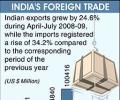
Exports grew to $16.34 billion while imports rose to $27.14 billion, leaving a trade deficit of $10.79 billion in July, according to official figures released in New Delhi on Monday. On the back of increase in global prices, the crude oil import bill in July shot up by 69.3 per cent to $9.48 billion from $5.6 billion a year ago.

'It is a blunt and dangerous attempt to pressure India to sign BTA on one-sided terms.'

India will continue to purchase Russian oil based on commercial viability and energy security needs, irrespective of US sanctions waivers, according to a senior petroleum ministry official.

State-run Oil and Natural Gas Corporation (ONGC) has approved the development of a 1.75 million tonnes (mt) strategic petroleum reserve (SPR) in Mangaluru, a project deemed of national importance, with plans for broad commercial utilisation.

A US-sanctioned tanker carrying Iranian crude oil is heading to India, marking the resumption of oil imports from Iran after seven years.

S&P Global Ratings warns that Indian oil marketing companies like IOC, BPCL, and HPCL may face reduced profit margins due to rising crude oil prices and government pressure to maintain stable retail prices.
